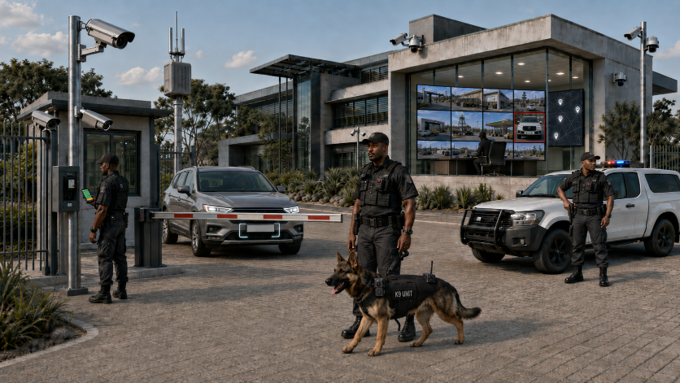
A connected site: identity at the gate, evidence on the officer, and every event visible to one control room.
Most private security companies already have plenty of technology in place. The problem is that those systems often produce separate records, making it harder to piece together what happened across a shift or incident. That becomes a real issue when a client later asks for proof of a patrol, response, or other service delivered.
A security company has to keep track of a lot during an ordinary shift. It needs to know that officers are where they should be, that incidents are properly recorded and that help can be sent quickly when someone is in trouble. The record also needs to stand up later if a client, insurer or disciplinary process asks what happened.
The difficulty is that the information behind those activities often sits in different places. Access control may be managed at the gate, patrol activity in another system, while cameras, radios and supervisor communications all create their own records. Sentiv’s approach is to connect those systems so activity can be viewed as part of the same operational history, from someone entering a site through to the response when an incident occurs.
“Most security companies are not short of technology. They are short of one record that holds together when a client, an insurer or a court asks what happened,” says Louis Du Toit, CEO at Sentiv. “When the gate, the officer and the control room write to the same timeline, that question can be answered in minutes rather than days.”
Starting with an identity at the gate
At the start of a shift, the first thing the company needs to know is who is actually on site. Biometric sign-on gives it a reliable record of that, while the same information can also feed attendance and payroll. If the occurrence book is digital, supervisors can see what is being logged during the shift without having to wait for a paper register to be checked later.
Visitors are linked to a named person and to the barrier event that let them in. Number plate recognition reads and checks each vehicle at the boom, before it is on site, and the read becomes part of the same visit record.
Evidence that does not depend on a decision
Body-worn cameras give officers a more reliable way to capture what happens during an incident, while models with push-to-talk can keep voice communication on the same device. Recordings can be encrypted and logged from the point of capture, which gives the organisation a clearer record to work with afterwards.
There are also situations where recording can start automatically. A holster sensor, for example, can activate the camera when an officer draws a sidearm, so the officer does not have to think about starting a recording during the incident. For K9 teams, cameras and tracking can extend that visibility to the dog as well as the handler, with both remaining visible to the control room.
Seeing the field and sending the nearest help
Live location places officers, vehicles and K9 units on one map, with a history that can be replayed to show a patrol route was completed. When an officer raises an alarm, the operator sees who, where and what the camera sees, and can route the nearest armed response unit to the site while staying in contact throughout.
Virtual patrol extends cover further, allowing many client sites to be monitored from one desk. Existing perimeter cameras do not need to be replaced; they are brought into the same evidence chain as everything else.
One record from first call to client report
With dispatch, voice, video and location on a shared timeline, an incident runs from first call to closure in a single workflow. The client report is assembled from the record itself: who responded, how long it took, what was seen and what was said. A vehicle of interest flagged at one site can also be flagged across every site the company protects.
“The record is still useful long after the incident itself is over,” says Du Toit. “Clients may want to see what happened, who responded and how the situation was handled. If that information is already captured properly, nobody has to reconstruct the event from notes at the end of a shift.”
Working with POPIA
Security systems often capture personal information as part of the job, whether that is a name at the gate, a vehicle registration or footage of someone entering a site. Sentiv therefore builds access and retention controls into the way those records are managed, so that only authorised people can view them and there is a clear record of who has done so.
Working with the operation already in place
None of this works if the control room loses contact with the field. Sentiv designs the communications layer around the site itself, using mission-critical radio together with other available connectivity where needed. The aim is to keep voice traffic and alerts moving even when normal network conditions become unreliable.
The configuration differs from one security company to the next. For some, officer safety and live video are the priority. For others, it is patrol proof or better management of evidence after a shift. Sentiv works with the cameras, radios and access hardware a company already owns, closing the riskiest gap first and extending from there.
For Sentiv, the aim is an operation that can answer the questions clients, insurers, and regulators ask, and keep officers safe on the shifts where it matters most.